Product Liability Insurance Coverage: The Ultimate Guide
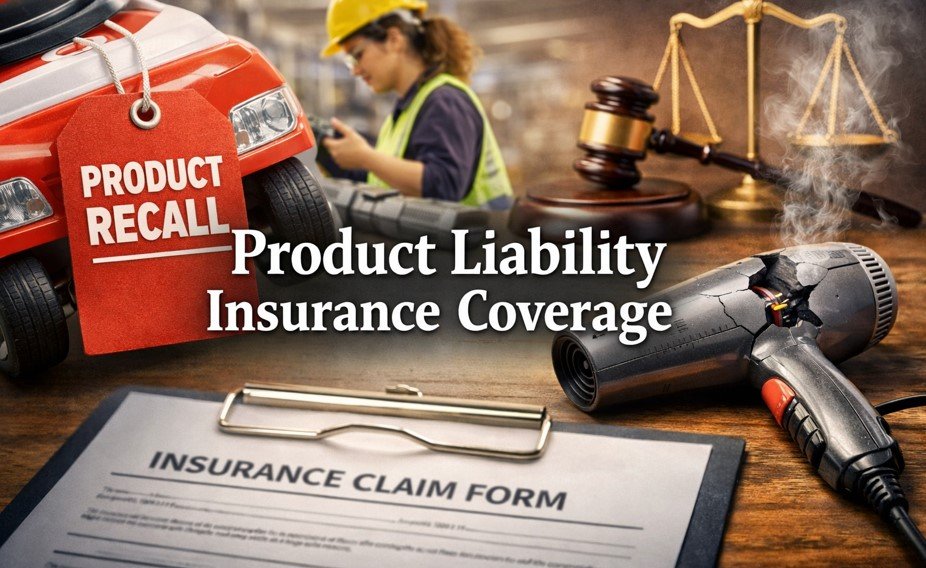
Product liability insurance coverage is the unsung hero of the modern business world, acting as a sturdy shield between your company’s assets and the unpredictable nature of consumer use.
Whether you are a small-scale artisan crafting organic soaps in a home studio or a global manufacturer assembling complex machinery, the reality is that any physical good you put into the stream of commerce carries an inherent risk.
Product liability insurance coverage provides the financial and legal protection necessary to survive claims that your product caused bodily injury or property damage to a third party.
In an era where consumer protection laws are robust and litigation is frequent, understanding this coverage isn’t just a “nice-to-have”, it is a fundamental pillar of risk management.
If a customer alleges that a defect in your product led to a fire in their home or an injury during use, this policy steps in to cover everything from medical bills and repair costs to the staggering fees of a legal defense team.
What Exactly is Product Liability Insurance Coverage?
To truly grasp the mechanics of product liability insurance coverage, one must look past the simple definition and into the complex legal and financial gears that move when a claim is filed.
It is not a monolithic shield but a sophisticated multi-layered defense system designed to catch the fallout from the moment a product leaves your control until it reaches the end of its lifecycle.
Product liability insurance coverage functions as a contractual promise between a business and an insurer, where the insurer assumes the financial burden of “strict liability” and negligence claims.
In the eyes of the law, if you put a product into the hands of a consumer, you are making an implied warranty that the product is safe for its intended use.
When that warranty is breached, whether through a fluke in the factory or a fundamental flaw in the blueprint, this coverage is the only thing standing between your company’s bank account and a potentially bankrupting judgment.
The Definition of the “Insured Product”
Before a policy can trigger, there must be a clear understanding of what constitutes the product under your product liability insurance coverage.
This isn’t always as simple as an item in a box. In the insurance world, a “product” includes the physical good itself, any containers or packaging associated with it, and the instructions or warnings provided alongside it.
The coverage typically applies once the product has physically left your premises and is no longer in your “care, custody, or control.”
This distinction is vital because if a product breaks while still in your warehouse, it is a property insurance issue; once it hits the delivery truck or the customer’s hands and causes harm, it shifts into the realm of product liability.
The Scope of Bodily Injury Protection
The primary driver for most high-value claims within product liability insurance coverage is bodily injury. This doesn’t just refer to immediate physical trauma, such as a cut or a broken bone caused by a malfunctioning tool; it extends to sickness, disease, and even death resulting from the use of the product.
For instance, if a food product is contaminated with bacteria or a skincare line causes a severe allergic reaction that leads to hospitalization, the bodily injury component of your policy kicks in.
It covers the victim’s medical bills, rehabilitation costs, and “pain and suffering” damages, which are often the most unpredictable and expensive parts of a legal settlement.
Property Damage and Consequential Loss
While physical injuries often grab the headlines, property damage is a frequent and costly trigger for product liability insurance coverage. This coverage applies when a defective product causes physical injury to “tangible property” belonging to a third party.
A classic example is a faulty toaster that catches fire and destroys a kitchen, or a leaking industrial valve that ruins a client’s expensive machinery. The policy covers the cost of repairing or replacing the damaged property.
However, it is important to note that the policy generally does not cover the cost of replacing the defective product itself (that is considered a business risk), but rather the resulting damage that the product caused to everything around it.
The “Duty to Defend” Clause
Perhaps the most underrated aspect of product liability insurance coverage is the “Duty to Defend.” In many ways, this is more valuable than the actual payout for damages.
Legal fees in product litigation are astronomical because they require specialized “toxic tort” or engineering lawyers, expert witnesses, and extensive laboratory testing to prove or disprove a defect.
Under this clause, your insurance company is obligated to provide and pay for your legal defense, even if the lawsuit against you is groundless, false, or fraudulent. This prevents a company from being bled dry by legal fees before they even get a chance to prove they weren’t at fault.
Investigation and Forensic Analysis
When a claim is made, product liability insurance coverage initiates a rigorous investigation process that a small or medium-sized business could never afford on its own.
Insurers employ forensic engineers and specialists to examine the failed product, review manufacturing logs, and determine exactly where the failure occurred.
This investigation serves two purposes: it builds a defense to protect the business from unfair claims, and it helps identify if a different entity in the supply chain (like a component part manufacturer) is actually the one responsible.
This process of “subrogation” allows your insurer to pay the claim and then go after the truly negligent party to recover the costs.
Coverage for Completed Operations
For businesses that provide a mix of products and services, such as HVAC installers, plumbers, or contractors, product liability insurance coverage is often bundled with “Completed Operations” insurance.
This specific facet of the policy protects you after a job is finished. If a plumber installs a water heater (the product) and three months later a connection fails and floods the house (the completed operation), the insurance handles the claim.
Without this specific wording, a business might find a “gap” where their general liability thinks the job is over, but the product liability hasn’t quite taken over, leaving the business owner exposed in the middle.
Who Needs This Coverage?
The necessity of product liability insurance coverage extends far beyond the entity that physically assembles a product; it is a critical safety net for every link in the modern commercial chain.
Because legal systems often follow the doctrine of “joint and several liability,” any business that touches a product, from the moment it is a raw material to the second it is swiped at a credit card terminal, can be named in a lawsuit if that product causes harm.
Product liability insurance coverage is therefore not a luxury for niche industries, but a foundational requirement for any business that participates in the stream of commerce.
Whether you are a digital drop shipper or a heavy industrial fabricator, the law assumes you have a duty of care to ensure the items you profit from do not jeopardize the safety of the public.
Below, we explore the specific roles that require this coverage and why their exposure is often greater than they realize.
Manufacturers and Fabricators
At the top of the risk pyramid, manufacturers require the most robust product liability insurance coverage because they maintain the highest level of control over the item’s creation.
Whether you are forging steel components or mixing chemical compounds for a new cleaning solution, the manufacturer is the primary target in any litigation involving design or manufacturing defects.
If a faulty weld causes a bicycle frame to snap or an incorrect chemical ratio leads to skin burns, the manufacturer is held to a standard of strict liability. This means the claimant doesn’t necessarily have to prove you were “careless”, they only have to prove the product was defective and that the defect caused their injury.
Without comprehensive coverage, a single production-line error could result in a catastrophic financial judgment that far exceeds the company’s annual revenue.
Wholesalers, Distributors, and Importers
Many intermediaries mistakenly believe they are exempt from needing product liability insurance coverage because they “never even opened the box.”
However, the law frequently treats distributors and wholesalers as extensions of the manufacturer, especially if the original maker is located overseas or is insolvent.
If you import electronics from a foreign factory that does not have a legal presence in your country, you effectively become the “manufacturer” in the eyes of the court. You are the domestic entity that introduced the risk into the local market.
Distributors are often pulled into “shotgun litigation,” where a plaintiff sues every name on the supply chain to see who has the deepest pockets or the best insurance policy; without your own coverage, you would be forced to pay for your own legal defense even if the fault lies entirely with the factory.
Retailers and E-commerce Sellers
Retailers are the “face” of the product to the consumer, and they are often the first party named when a customer seeks damages. Even if a retail store did nothing to alter the product, they are a vital link in the chain of distribution that requires product liability insurance coverage.
In many jurisdictions, “seller liability” allows a consumer to sue the store where an item was purchased simply because that store provided the platform for the transaction. This is particularly relevant for e-commerce sellers on platforms like Amazon or eBay.
These platforms now frequently mandate that third-party sellers carry a minimum amount of liability insurance. If a toy sold through an online shop is found to contain lead or presents a choking hazard, the seller can be held liable for the resulting medical costs and emotional distress.
Private Labelers and Re-branders
A unique and high-risk category involves businesses that engage in “white labeling” or “private labeling.” If you purchase a generic product from a third party but slap your own logo, branding, and packaging on it, you are legally considered the manufacturer.
Your product liability insurance coverage must reflect this reality. By putting your name on the product, you are vouching for its safety and taking ownership of its design and marketing. Courts argue that the consumer is relying on your brand’s reputation when they make the purchase.
Consequently, if the generic internal component fails, you cannot simply point the finger at the anonymous factory; you are the one who marketed the product as your own, and you will be held to the highest standard of accountability.
Raw Material and Component Suppliers
It is a common misconception that if you only make a “part” of a product, you don’t need product liability insurance coverage. In reality, component manufacturers, those making the batteries, the specialized screws, or the internal circuitry, are frequently the ultimate targets of subrogation.
If a smartphone explodes, the phone manufacturer’s insurance will pay the initial claim and then immediately sue the battery supplier to recover those funds. If you supply raw ingredients to a food company and those ingredients are found to be the source of an E. coli outbreak, your business is on the hook for the entire fallout.
Component suppliers need tailored coverage that accounts for how their specific part interacts with a finished good, ensuring they aren’t left holding the bill for a multi-million dollar class-action suit.
The True Cost of a Claim: Why Coverage Matters
To truly understand the gravity of a legal claim, one must look past the initial shock and examine the cascading financial consequences that follow.
Product liability insurance coverage is not just an expense; it is a vital buffer against a reality where the costs of a single defect can multiply at an alarming rate.
Product liability insurance coverage acts as a lifeline because the “true cost” of a claim often resembles an iceberg, the immediate settlement is merely the visible tip, while the massive, submerged expenses of litigation, investigation, and brand erosion can sink even the most profitable enterprise.
As we move into 2026, the landscape of liability is shifting, with “social inflation” driving jury verdicts to record highs and the complexity of modern products making the defense of these cases more expensive than ever before.
The Crushing Weight of Legal Defense Fees
One of the most immediate and overwhelming costs associated with a product claim is the price of an elite legal defense, which product liability insurance coverage is designed to absorb. Even if your business is completely innocent, the cost to prove that innocence in court can be staggering.
In 2026, specialized defense attorneys often charge between $300 and $800 per hour, and a single complex case can take 18 to 36 months to resolve. During this time, your business must pay for every deposition, every court filing, and every hour of document review.
Without insurance, these fees are paid out-of-pocket, draining the cash reserves you need for payroll, R&D, and daily operations.
The High Price of Expert Witnesses and Forensic Analysis
Defending a product requires more than just a good lawyer; it requires scientific proof, a cost that is a core component of product liability insurance coverage.
To debunk a claim of a “design defect,” you may need to hire independent forensic engineers, toxicologists, or materials scientists who charge upward of $500 per hour to testify on your behalf.
These experts must perform rigorous testing on your product to demonstrate that it met all safety standards or that the consumer’s misuse was the actual cause of the injury.
The logistical costs of these investigations, including laboratory rentals and the shipping of evidence, can easily reach six figures before a trial even begins.
Compensatory Damages and the “Settlement Floor”
The primary function of product liability insurance coverage is to pay for the actual damages suffered by the claimant, which are reaching new heights in the current economic climate.
Compensatory damages include not only the victim’s immediate medical bills but also their lost future wages, the cost of long-term rehabilitation, and “pain and suffering” awards.
In 2025 and 2026, we have seen a significant rise in the “settlement floor,” where even relatively minor injuries result in payouts between $10,000 and $500,000. For serious or permanent injuries, jury verdicts frequently exceed $7 million. For a business without coverage, paying such a judgment is often impossible, leading directly to insolvency.
The Threat of Punitive Damages and Social Inflation
In cases where a jury believes a company was reckless or ignored safety warnings, they may award punitive damages, a cost that product liability insurance coverage can help manage, depending on the policy and jurisdiction.
Unlike compensatory damages, which aim to “make the victim whole,” punitive damages are designed specifically to punish the company and deter others. We are currently seeing a trend of “social inflation,” where juries, fueled by a general distrust of corporations, are awarding multi-billion dollar punitive judgments.
Even for a medium-sized business, a punitive award can be ten times the amount of the actual damages, creating a financial burden that no amount of traditional savings can cover.
The Invisible Drain of Business Interruption
While the legal battle rages, the “true cost” includes the massive distraction and operational slowdown that product liability insurance coverage helps mitigate. When a major claim hits, the leadership team is often forced to pivot from growing the business to managing the crisis.
Executives may spend hundreds of hours in depositions and meetings with counsel, leading to “management distraction” that causes strategic projects to stall and employee morale to dip.
Furthermore, if a production line must be halted for investigation or if a lender pulls your credit line due to the “pending litigation” on your books, the resulting loss of revenue can be just as damaging as the lawsuit itself.
Long-term Reputational Damage and Brand Erosion
Perhaps the most difficult cost to quantify is the loss of trust, which is why product liability insurance coverage often includes “crisis management” endorsements. Once a product is associated with an injury in the public eye, sales can plummet overnight.
Rebuilding a brand’s reputation requires expensive PR campaigns, discounts to win back distributors, and years of perfect performance to erase the memory of the defect. The “indirect loss” of future sales and diminished brand equity can haunt a company for a decade.
Insurance provides the resources to handle the initial firestorm professionally, helping to contain the narrative and preserve the long-term viability of the brand.
Factors That Influence Your Premium
In the competitive landscape of 2026, product liability insurance coverage premiums are no longer calculated using simple flat rates. Insurers have transitioned to highly sophisticated, data-driven models that scrutinize every facet of a business’s operational DNA.
As global trade becomes more volatile and “social inflation” drives record-breaking legal settlements, underwriters are looking far beyond your annual sales figures to determine how much you should pay for protection.
Product liability insurance coverage costs are influenced by a dynamic interplay of your internal risk management, external economic pressures, and the inherent “danger profile” of your products.
In an era where AI-driven underwriting can flag subtle risk indicators in real-time, understanding these influencing factors is the first step toward securing favorable rates and maintaining your company’s bottom line.
Product Risk Category and Inherent Hazard
The most significant weight in determining your product liability insurance coverage premium is the “hazard class” of the product itself. Underwriters categorize products based on the severity of harm they could realistically cause.
For example, a manufacturer of children’s car seats or invasive medical devices will naturally pay significantly higher premiums than a company producing office stationery.
In 2026, insurers are particularly cautious about products involving lithium-ion batteries, ingestible supplements, and autonomous AI-driven hardware, as these categories are currently linked to high-frequency and high-severity claims.
The more “life-critical” or “high-energy” your product is, the more the insurer will charge to offset the potential for a multi-million dollar bodily injury claim.
Supply Chain Complexity and Transparency
In today’s interconnected market, the “length” and “clarity” of your supply chain are pivotal factors for product liability insurance coverage. Insurers now utilize “Supply Chain Resilience” scores to price policies.
If you source components from a single, unverified factory in a region with poor regulatory oversight, your premium will spike because the insurer views you as having a “single point of failure” with no recourse.
Conversely, businesses that can provide audit-ready documentation, real-time tracking of raw materials, and proof of supplier redundancy are seen as lower risk. In 2026, “blind spots” in your sourcing, where you don’t know exactly who made a sub-component, are treated as high-risk liabilities that lead to steep premium surcharges.
Social Inflation and Litigation Trends
A factor largely outside of a business’s control, but central to product liability insurance coverage pricing, is the trend of “social inflation.”
This refers to the rising costs of insurance claims resulting from societal shifts, such as the increasing popularity of third-party litigation funding and a growing “anti-corporate” sentiment among juries.
In 2026, “nuclear verdicts” (awards exceeding $10 million) have become more common, forcing insurers to raise baseline premiums across the board to maintain their reserve funds.
Underwriters specifically look at the “litigation climate” of where your products are sold; if your primary market is a jurisdiction known for aggressive consumer protection lawsuits, your premium will reflect that heightened legal exposure.
Annual Revenue and Market Reach
The scale of your operations acts as a multiplier for your product liability insurance coverage premium. Generally, premiums are calculated as a rate per $1,000 of gross sales. Higher revenue signals a higher “volume of risk”; essentially, the more units you have in the hands of consumers, the greater the statistical likelihood that one will fail and trigger a claim.
Furthermore, your geographic reach matters; a company selling exclusively to local boutique shops faces less exposure than one selling globally via major e-commerce platforms.
Selling in international markets requires the insurer to account for diverse legal systems and higher costs of cross-border legal defense, which directly inflates the premium.
Quality Control (QC) and AI Integration
In 2026, the sophistication of your quality control department is a major “credit” factor that can lower your product liability insurance coverage costs.
Insurers are increasingly offering discounts to companies that integrate AI and IoT sensors into their manufacturing lines to detect defects before products ship.
If you can demonstrate a “closed-loop” quality system, where every defect is logged, analyzed, and used to improve the next batch, you prove to the underwriter that you are a proactive rather than reactive risk.
Documentation is king here; the ability to provide digital “pedigrees” for every product batch shows a level of professional discipline that can shave 10% to 20% off a standard premium.
Claims History and “Loss Runs”
Your past performance remains the most reliable predictor of future risk for product liability insurance coverage. Insurers look at your “loss runs”, a detailed report of claims made against you over the last five to ten years.
A “frequency” problem (many small claims) often suggests a systemic failure in quality control, while a “severity” problem (one massive claim) might indicate a fundamental design flaw. Even “closed” claims where you were found not at fault still impact your premium, as the insurer had to pay for your legal defense.
In the current market, a clean five-year record is the most powerful tool a business has to negotiate lower rates, as it proves your risk management strategies are effectively preventing losses.
Conclusion
In the complex ecosystem of global commerce, product liability insurance coverage is the safety net that allows innovation to thrive. It gives manufacturers the confidence to create, retailers the security to sell, and consumers the peace of mind that there is recourse if things go wrong. By investing in a robust policy, you aren’t just buying a piece of paper; you are buying the continued existence of your brand. Don’t wait for a process server to knock on your door to realize the value of this protection.