How to Secure the Germany Employment Visa: Your 2026 Ultimate Guide
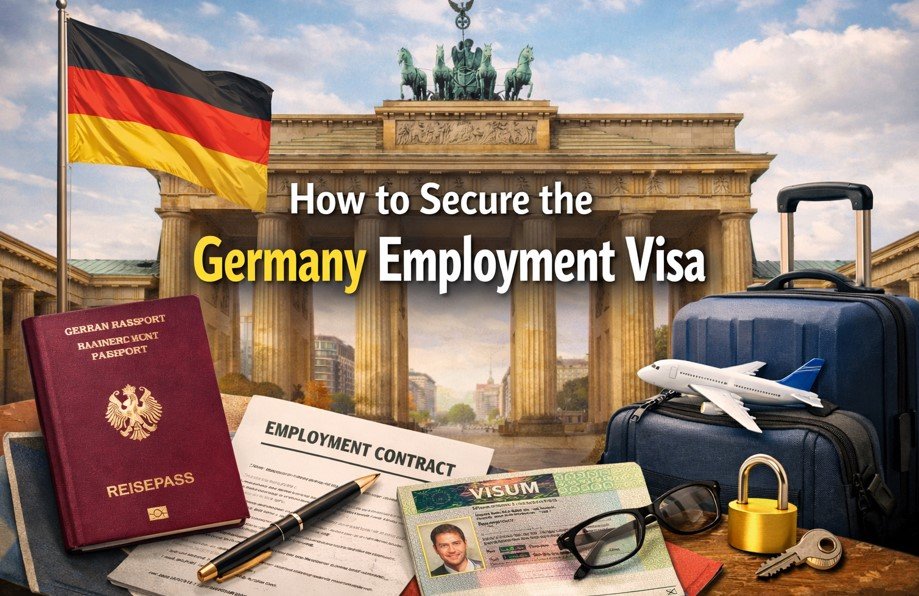
The Germany Employment Visa is your primary gateway to one of the world’s most stable and thriving economies, offering a high quality of life and unparalleled career growth.
As of 2026, the German government has further streamlined the application process, making it more accessible for skilled professionals from across the globe to bring their expertise to the German labor market.
Securing a Germany Employment Visa requires a strategic approach, a clear understanding of the latest legislative updates, and meticulous attention to documentation.
Whether you are a software engineer, a healthcare professional, or a specialist in the trades, navigating the pathways, from the traditional work permit to the innovative Opportunity Card, is the first step toward your European dream.
Why Choose Germany for Employment Visa?
The decision to pursue a Germany Employment Visa is often the most significant turning point in a professional’s international career.
Beyond the mere acquisition of a work permit, choosing Germany means aligning your future with a nation that fundamentally respects the contribution of the individual to the collective economic engine.
In 2026, the incentives for moving to Germany have reached an all-time high, driven by a combination of progressive labor reforms, a desperate need for skilled talent, and a social system that remains the envy of the Western world.
When you secure a Germany Employment Visa, you aren’t just getting a job; you are gaining access to a lifestyle defined by stability, fairness, and a deep-rooted commitment to human dignity.
Unrivaled Economic Stability and Job Security
Germany is the undisputed economic powerhouse of Europe, a title it has maintained through decades of global shifts. For a holder of the Germany Employment Visa, this translates to a level of job security that is rare in the volatile modern market.
The German “Mittelstand”, the small and medium-sized enterprises that form the backbone of the economy, are world leaders in specialized niches, ensuring that the demand for skilled workers remains constant even during global downturns.
Furthermore, German labor laws provide some of the strongest protections against unfair dismissal in the world.
Once you have passed your probationary period, your employer must follow strict legal guidelines to terminate a contract, providing you with a mental peace that allows you to focus on your craft rather than your survival.
World-Class Healthcare System Based on Solidarity
One of the most compelling reasons to apply for a Germany Employment Visa is the immediate access it grants to a healthcare system ranked among the top ten globally.
In 2026, Germany’s “Solidarity Principle” ensures that every resident receives high-quality medical care regardless of their income level.
The system is split into statutory (public) and private insurance, with the vast majority of employees opting for the former. What makes this truly special is that the costs are shared equally between you and your employer.
Once you are insured, you receive an electronic health card that covers everything from routine check-ups and specialist consultations to complex surgeries and hospital stays, often with no out-of-pocket costs at the point of service.
This safety net is invaluable, especially for those moving with families, as non-working spouses and children are often covered under the primary earner’s policy for free.
A Masterclass in Work-Life Balance
The culture surrounding the Germany Employment Visa is one that views work as a part of life, not the entirety of it. Germany is famous for its “Feierabend” culture, the clear boundary between the end of the workday and the start of personal time.
Unlike many other global hubs where 60-hour weeks are the norm, Germany mandates strict limits on working hours, usually capped at 8 hours per day.
Perhaps most impressive is the vacation policy; while the legal minimum is 20 days, the vast majority of German companies offer between 28 and 30 days of paid annual leave.
When combined with public holidays, it is not uncommon for professionals to enjoy six weeks of time off per year. This systemic commitment to rest ensures that employees remain productive, creative, and, most importantly, healthy over the long term.
Exceptional Quality of Life and Infrastructure
Living in Germany under a Germany Employment Visa means inhabiting a country designed for efficiency and comfort. Whether you settle in a bustling metropolis like Berlin or a historic city like Nuremberg, you will find an infrastructure that works.
The public transportation network, comprising the U-Bahn, S-Bahn, and high-speed ICE trains, is so reliable and comprehensive that many expats find they never need to own a car. Beyond transit, Germany consistently ranks high in safety, air quality, and urban cleanliness.
The country is also a haven for outdoor enthusiasts, with thousands of kilometers of hiking trails, pristine forests, and public parks that are integrated into the heart of every city.
This high standard of living is surprisingly affordable compared to other major hubs like London, New York, or Paris, particularly when considering the quality of public services provided.
A Clear and Rapid Path to Permanent Residency
For many, the Germany Employment Visa is not a temporary stop but a gateway to a permanent new home. Germany has some of the most favorable “settlement permit” (Niederlassungserlaubnis) laws in the European Union.
If you hold an EU Blue Card, you can often apply for permanent residency in as little as 21 months if you demonstrate B1-level German skills, or 33 months with basic A1 skills.
Even for those on standard skilled worker visas, the path to staying indefinitely is clear and bureaucratic hurdles are being actively reduced by the government.
In 2026, the transition from a temporary visa to becoming a permanent part of German society is faster and more transparent than ever, reflecting the nation’s genuine desire to integrate international talent into its long-term future.
Types of Germany Employment Visas
The process of obtaining a Germany Employment Visa has been transformed in 2026, offering a more diverse array of pathways than ever before.
Whether you are a high-earning executive, a self-taught tech genius, or someone looking to start their career from scratch through vocational training, there is a specific legal track designed for your situation.
Choosing the right one is critical, as each comes with its own salary thresholds, document requirements, and long-term residency benefits.
1. The EU Blue Card
The EU Blue Card remains the most sought-after Germany Employment Visa for highly qualified professionals holding a university degree. In 2026, the German government has refined the salary thresholds to reflect the current economic climate, setting the standard annual gross salary requirement at €50,700.
However, for those in “shortage occupations”, a list that now includes not just IT and engineering, but also healthcare, teaching, and even certain management roles in manufacturing, the threshold is significantly lower at €45,934.
The true power of the Blue Card lies in its “fast-track” to permanent residency: if you can demonstrate B1-level German language proficiency, you can obtain a settlement permit in just 21 months, making it the quickest path to making Germany your forever home.
2. The Skilled Worker Visa
For those whose qualifications are recognized in Germany but who may not meet the high salary requirements of the Blue Card, the Skilled Worker Visa (Sections 18a and 18b) is the primary Germany Employment Visa option.
One of the most significant updates in 2026 is the “decoupling” of the job role from the specific degree; as long as you have a recognized qualification and a job offer for a “qualified” position, you are no longer strictly required to work in the exact field of your studies.
This provides immense flexibility for professionals looking to pivot their careers within the German market.
This visa typically requires the approval of the Federal Employment Agency to ensure the working conditions are comparable to those of local employees, maintaining a fair standard for all workers in the country.
3. The Opportunity Card (Chancenkarte): Entry Without a Job Offer
The Opportunity Card is the most innovative addition to the Germany Employment Visa family, designed for individuals who have the skills but haven’t yet secured a contract.
This points-based visa allows you to enter Germany for up to one year specifically to look for work. You qualify by earning at least six points based on criteria such as your age, language skills (German or English), work experience, and previous ties to Germany.
While on this visa, you are legally permitted to work up to 20 hours per week in any job to support yourself, providing a financial cushion as you interview for full-time professional roles. It is the perfect “bridge” for talented individuals who prefer to network and find their ideal employer while actually being on the ground in Germany.
4. The IT Specialist Visa: Experience Over Academics
Recognizing that the tech world moves faster than traditional education, the Germany Employment Visa for IT Specialists allows tech professionals to work in Germany even without a university degree.
In 2026, the requirements have been streamlined: if you can prove at least three years of relevant professional experience within the last seven years and have a job offer with a salary of at least €45,934, you can qualify for a residence permit.
This track acknowledges that certifications, portfolios, and years of hands-on coding or systems architecture are often more valuable than a diploma. It is a bold move that has made Germany one of the top destinations for global tech talent who may have taken non-traditional paths to expertise.
5. The Vocational Training (Ausbildung) Visa: Learning on the Job
For those at the beginning of their professional journey, the Vocational Training Visa offers a unique Germany Employment Visa pathway that combines education with paid work.
Germany’s “Dual Education System” is world-renowned, allowing you to spend three days a week training at a company and two days at a vocational school.
In 2026, this visa is increasingly popular in sectors like nursing, hospitality, and the skilled trades. To qualify, you generally need a B1 level of German and a training contract from a German employer.
The best part? After you complete your 2- to 3-year apprenticeship, you are almost guaranteed a full-time Skilled Worker Visa, as you will already be fully integrated into the German labor market and speak the language fluently.
6. The Freelance and Self-Employment Visa: For the Independent Spirit
If you prefer to be your own boss, the Self-Employment (Gewerbe) or Freelance (Freiberufler) Visa is the specific Germany Employment Visa track for you.
This pathway is designed for artists, writers, consultants, and entrepreneurs who can prove that their business will have a positive impact on the German economy. Unlike the employee-based visas, this requires a robust business plan, evidence of potential clients (letters of intent), and proof of sufficient financial reserves to sustain your business and life.
In 2026, the application process has moved almost entirely online through the “Work and Stay Agency,” though the scrutiny remains high, you must demonstrate that there is a “regional need” or economic interest in the services you plan to provide.
Step-by-Step Guide on How to Secure the Germany Employment Visa
Securing a Germany Employment Visa in 2026 is a journey of precision. The German government has moved toward a “digital-first” approach, meaning your success depends as much on your ability to navigate online portals as it does on your professional qualifications.
By following these expanded steps, you can move through the bureaucracy with the confidence of a seasoned local.
Step 1: Secure a Binding Job Offer or Contract
The foundation of most Germany Employment Visa applications is a formal offer from a German employer. In 2026, a simple “letter of intent” is rarely enough; you need a signed employment contract that clearly outlines your gross annual salary, your specific job title, and a detailed description of your duties.
This document is the “anchor” for your visa. Your employer must also provide a completed Erklärung zum Beschäftigungsverhältnis (Declaration of Employment), which acts as a formal confirmation to the authorities that the job is legitimate and that the working conditions meet German labor standards.
Step 2: Verify and Recognize Your Qualifications
Before the government grants a Germany Employment Visa, they must be certain your skills match German standards. You must check the Anabin database to see if your university is rated H+ and if your specific degree is listed as “entspricht” (equivalent).
If your degree or university isn’t found, or if you are in a regulated profession like medicine or law, you must apply for a Statement of Comparability from the Central Office for Foreign Education (ZAB). In 2026, this process is digital, but it can still take several weeks, so it is vital to start this step the moment you begin your job hunt.
Step 3: Initiate the Digital Application via the Consular Services Portal
The most significant change in 2026 is the mandatory use of the Consular Services Portal (digital.diplo.de) for initial applications.
Instead of waiting months for a paper appointment, you now upload high-quality scans of your passport, contract, and recognition proof directly to the portal. This “pre-check” phase allows German officials to review your file for completeness.
If a document is missing or incorrect, they will notify you digitally, saving you from a wasted trip to the embassy. Only after your digital file is cleared will you receive a link to book your final in-person appointment.
Step 4: Attend the In-Person Biometric Appointment
Once your digital application is “pre-cleared,” you must visit the German Embassy or Consulate in your home country.
While much of the work is done, this step is non-negotiable for the Germany Employment Visa because the authorities must verify your identity and collect your biometric data (fingerprints and a fresh photo).
You will also present the original versions of the documents you uploaded online. In 2026, these appointments are streamlined and typically last only 15 minutes, as the case officer already has your digital file open and verified on their screen.
Step 5: Visa Approval and the “Incoming” Insurance
After the interview, the processing time for a Germany Employment Visa in 2026 has been reduced to an average of 4 to 6 weeks for skilled workers. Once approved, you will be asked to submit your passport for the visa sticker.
At this stage, you must provide proof of “Incoming Health Insurance.” This is a temporary policy that covers you from the moment you land in Germany until your official German statutory health insurance (which is tied to your salary) kicks in on your first day of work.
Step 6: Arrival, Registration, and Residence Permit
The visa in your passport is usually valid for 6 or 12 months, it is an entry permit, not your final “ID card.” Within your first two weeks of arriving in Germany, you must visit the local Bürgeramt to complete your Anmeldung (address registration).
Finally, you will make an appointment with the local Ausländerbehörde (Foreigners’ Authority) to swap your entry visa for a biometric residence permit.
In many German cities in 2026, this final step is also managed through the Work and Stay Agency, ensuring that your transition from “applicant” to “resident” is as smooth as possible.
Common Pitfall to Avoid during Your Applications
Applying for a Germany Employment Visa in 2026 is a process that rewards meticulousness and punishes even the smallest oversight.
Because the German authorities have shifted to a “digital-pre-check” model, errors that once might have been caught and corrected at a counter now often lead to an immediate digital rejection.
To ensure your journey is successful, you must proactively guard against the common pitfalls that trip up thousands of applicants every year.
1. The “Anabin” Mismatch: Incomplete Qualification Recognition
One of the most frequent reasons for a Germany Employment Visa denial is assuming that a university degree is automatically recognized.
Many applicants print out a “General University Recognition” (H+) from the Anabin database but fail to check if their specific degree (e.g., Bachelor of Science in Cloud Architecture) is also listed as equivalent (Entspricht).
If your specific degree is not listed exactly as it appears on your diploma, the visa officer cannot approve your application. In 2026, the solution is the ZAB Statement of Comparability.
Falling into the trap of skipping this €208 evaluation when your degree isn’t 100% matched on Anabin is a guaranteed way to have your application returned.
2. Salary Threshold Ignorance: Falling Below the Legal Limit
The Germany Employment Visa is strictly tied to wage protection laws. A common pitfall occurs when an applicant signs a contract that they believe is high, only to find it falls €100 short of the EU Blue Card or Skilled Worker threshold for 2026.
German authorities update these figures annually to adjust for inflation. If your contract states a gross salary of €45,000 but the 2026 requirement for your specific role is €45,934, your visa will be rejected.
Always double-check the “Current Year Thresholds” before signing your contract, and don’t be afraid to ask your employer to adjust the salary to meet the legal minimum for your visa type.
3. The “Insurance Gap”: Submitting Inadequate Health Coverage
Many applicants mistakenly believe that their standard travel insurance or their future German employer-sponsored insurance is enough for the visa interview. This is a critical error.
For a Germany Employment Visa, you must provide proof of “Incoming” or “Expat” insurance that specifically covers the period from your arrival until your first day of work.
In 2026, the embassy requires this insurance to have no “deductible” (Selbstbeteiligung) and to cover at least €30,000 in medical expenses, including repatriation. Using a cheap travel policy that lacks these specific clauses is one of the most common reasons for processing delays.
4. Financial “Buffer” Errors in Blocked Accounts
For those applying for the Opportunity Card or a job-seeker track, the Blocked Account (Sperrkonto) is mandatory. A common pitfall in 2026 is depositing the exact minimum required amount (e.g., €13,092).
Applicants often forget that international bank transfer fees and currency fluctuations can cause the final amount arriving in Germany to be slightly lower. If your account shows €13,091.50 instead of the full required amount, your Germany Employment Visa can be delayed.
Experts recommend adding a “buffer” of at least €150 to €200 to your transfer to ensure the final blocked balance is indisputably above the legal requirement.
5. Generic Motivation Letters: The “Copy-Paste” Trap
While your skills get you the job, your Motivation Letter convinces the visa officer of your intentions. A major pitfall is submitting a generic letter found online that says, “I have always dreamed of living in Germany.” In 2026, visa officers look for a “concrete integration plan.”
Failing to mention specific cities you plan to live in, your strategy for improving your German language skills, or how your specific niche (like “Automotive Embedded Systems”) benefits the German economy can make your application appear “low-effort.”
A weak motivation letter is often interpreted as a lack of genuine intent to integrate, which can lead to increased scrutiny.
6. Signature and Photo Non-Compliance
It sounds minor, but technical non-compliance is a leading cause of “immediate rejection” at the biometric stage. In 2026, the Germany Employment Visa photos must be strictly biometric: no smiling, a neutral gray background, and specific head-to-frame ratios.
Furthermore, digital signatures are often rejected on official forms like the VIDEX. If you upload a document with a “stylized” digital signature instead of a hand-signed, scanned original, the system may flag it as invalid.
Always sign with a blue or black pen and scan the document in high resolution to avoid these “silly” but fatal mistakes.
Conclusion
Securing the Germany Employment Visa in 2026 is more a matter of precision than luck. With the digitalization of the process and the introduction of the Opportunity Card, the “engine room of Europe” is more open than ever. By preparing your documents early, ensuring your qualifications are recognized, and targeting the right salary bracket, you can move from applicant to resident in a matter of months.