Top Industries in Australia Offering Employer Sponsored Visas
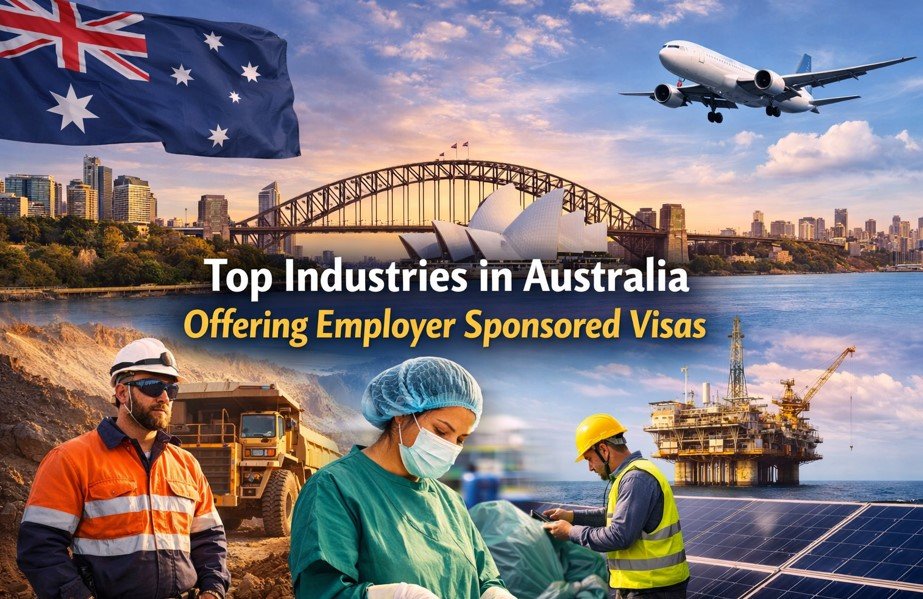
Top Industries in Australia Offering Employer Sponsored Visas have become the primary focus for skilled professionals looking to build a career and a life in one of the world’s most stable economies.
As the global hunt for talent intensifies, the Australian government and private sectors have increasingly turned to sponsorship pathways to bridge critical gaps in the domestic workforce.
For many international applicants, securing a “Skills in Demand” visa or an Employer Nomination Scheme (ENS) subclass 186 visa represents more than just a job offer, it is a direct ticket to professional growth and, often, a streamlined pathway to permanent residency.
Top Industries in Australia Offering Employer Sponsored Visas are currently being shaped by a massive shift toward essential services, digital infrastructure, and the “green” energy transition.
In 2026, the migration landscape has evolved to prioritize sectors that provide long-term economic resilience rather than short-term labor fixes.
If you are an engineer, a healthcare professional, or a specialist in the trades, understanding which industries are the most “sponsor-friendly” is the first step in navigating the complex Australian visa system.
Understanding the Visa Subclasses for These Industries
To truly capitalize on the Top Industries in Australia Offering Employer Sponsored Visas, you must first master the technical landscape of the visa subclasses themselves.
Each subclass serves a distinct economic purpose, from filling immediate “fire-drill” vacancies in tech to securing the long-term future of regional healthcare.
In 2026, the Australian migration framework has been refined to be more “worker-centric,” meaning that for the first time in nearly a decade, almost every employer-sponsored pathway leads to a potential permanent residency (PR) outcome. Understanding these legal avenues is just as critical as having the right professional skills.
The Skills in Demand (Subclass 482) Visa
The Skills in Demand visa, which officially replaced the legacy TSS 482 system, is the most common entry point for professionals entering the Top Industries in Australia Offering Employer Sponsored Visas.
This visa is divided into three distinct streams: Specialist Skills, Core Skills, and Essential Skills. The “Specialist Skills” stream is particularly lucrative for high-end tech and engineering roles, offering expedited processing for those earning over $146,717 per year.
For most other professionals, the “Core Skills” stream covers the bulk of occupations on the Core Skills Occupation List (CSOL), requiring a minimum salary (TSMIT) that is currently indexed at $79,499.
One of the most significant 2026 reforms to this visa is the enhanced “mobility” provision, which allows sponsored workers to switch employers more easily without losing their visa status, provided they remain within the same industry sector.
Employer Nomination Scheme (Subclass 186)
The Subclass 186 visa is the “gold standard” for those targeting the Top Industries in Australia Offering Employer Sponsored Visas because it grants immediate permanent residency. This visa is typically accessed via two main streams: Direct Entry and Temporary Residence Transition (TRT).
Under the TRT stream, workers who have held a temporary sponsored visa (like the 482) for at least two years with the same employer can be nominated for PR. The Direct Entry stream is more rigorous, requiring a formal skills assessment and at least three years of relevant post-qualification work experience.
In industries like Healthcare and STEM, many employers now use the promise of a 186 nomination as a powerful recruitment tool to attract the world’s best talent, making it a primary target for mid-to-senior level professionals.
Skilled Employer Sponsored Regional (Subclass 494)
For those willing to look beyond the major metropolitan skylines, the Subclass 494 visa is a high-priority pathway within the Top Industries in Australia Offering Employer Sponsored Visas.
This is a “provisional” visa valid for five years, specifically designed to address chronic labor shortages in regional areas (which includes everywhere in Australia except Sydney, Melbourne, and Brisbane).
It offers a much wider range of eligible occupations, nearly 650, compared to the metropolitan lists. The primary benefit of the 494 is the “Regional Transition” to permanent residency; after living and working in a regional area for just three years, holders can apply for the Subclass 191 permanent visa.
Regional employers are often more motivated to sponsor and may offer higher incentives to compensate for the location.
Designated Area Migration Agreements (DAMA)
The DAMA framework is a niche but incredibly powerful “sub-program” under the 482 and 494 subclasses that specifically benefits the Top Industries in Australia Offering Employer Sponsored Visas in remote areas.
A DAMA is a formal agreement between the government and a specific region (like the Goldfields or Northern Territory) that allows for “concessions” not available in the standard program.
These concessions might include lower English language requirements, a higher age limit (up to 55 years instead of 45), and even salary concessions. For workers in industries like Agriculture, Aged Care, or Hospitality, a DAMA might be the only viable pathway to sponsorship if they do not meet the strict criteria of the standard skilled lists.
Training Visa (Subclass 407)
The Subclass 407 Training Visa acts as a “bridge” for early-career professionals looking to break into the Top Industries in Australia Offering Employer Sponsored Visas. Unlike the other subclasses, the 407 is not for standard employment; it is for occupational training and professional development.
It allows an Australian organization to sponsor a foreign national to participate in a structured, workplace-based training program for up to two years. This is an excellent option for recent graduates or those who need to obtain Australian-specific licensing or registration (common in Healthcare and Trades).
While it is a temporary visa, many 407 holders successfully transition to a 482 or 186 visa once they have completed their training and gained the necessary “on-shore” experience.
Top Industries in Australia Offering Employer Sponsored Visas
To build a successful career and secure permanent residency, understanding the Top Industries in Australia Offering Employer Sponsored Visas is essential for any skilled professional.
As the nation faces structural labor shortages and a rapid transition toward a digital and green economy, certain sectors have emerged as the primary drivers of the migration program.
These industries are not just looking for workers; they are looking for long-term partners to help build the country’s future.
Top Industries in Australia Offering Employer Sponsored Visas are currently dominated by sectors that provide “essential” services, healthcare, construction, and education, alongside high-growth areas like technology and renewable energy.
For many applicants, navigating the path to a 482 (Temporary Skill Shortage) or 186 (Employer Nomination Scheme) visa begins with identifying which of these industries has the highest “sponsorship appetite.”
1. Healthcare and Social Assistance
The healthcare sector remains the undisputed leader among the Top Industries in Australia Offering Employer Sponsored Visas.
With an aging population and a significant increase in government funding for disability and aged care, the demand for medical professionals has reached a critical level. Unlike other sectors that may fluctuate with the economy, healthcare is “recession-proof,” making it a highly stable path for international talent.
- Registered Nurses: Specializations in aged care, mental health, and perioperative nursing are seeing the highest sponsorship rates.
- General Practitioners and Specialists: Regional areas, in particular, offer lucrative sponsorship packages to attract doctors.
- Allied Health Professionals: Physiotherapists, occupational therapists, and speech pathologists are in high demand to support the National Disability Insurance Scheme (NDIS).
Hospitals and private healthcare providers are often “Accredited Sponsors,” meaning they receive priority processing for visa applications, sometimes getting approvals in just a few days.
2. Information Technology and the Digital Economy
In 2026, the digital revolution continues to place technology at the forefront of the Top Industries in Australia Offering Employer Sponsored Visas.
As Australian businesses across all sectors, from finance to agriculture, adopt AI, cloud computing, and advanced data analytics, the “war for talent” has gone global. Tech giants and agile startups alike are increasingly relying on sponsorship to fill roles that local universities simply cannot produce fast enough.
- Cybersecurity Specialists: With the rise in sophisticated data threats, experts in network security and risk mitigation are top priorities.
- Software Engineers and Developers: Full-stack developers and AI specialists are consistently on the Core Skills Occupation List.
- ICT Business Analysts: Professionals who can bridge the gap between technical teams and business stakeholders are highly valued.
Many tech companies offer “relocation packages” alongside sponsorship, recognizing that high-tier digital talent is a mobile and global commodity.
3. Construction and Infrastructure
Driven by a national housing crisis and a massive $120 billion government investment in transport and civil projects, construction is one of the most robust Top Industries in Australia Offering Employer Sponsored Visas.
The industry needs more than just manual labor; it requires highly skilled managers and engineers to oversee complex, multi-year projects that are essential for the country’s growing population.
- Construction Managers: Tasked with keeping large-scale residential and commercial developments on track and within budget.
- Civil and Structural Engineers: Essential for the design and safety of roads, bridges, and skyscrapers.
- Surveyors: High demand for technical experts who provide the foundational data for all infrastructure growth.
The 482 visa is a very common entry point here, with many firms providing a clear pathway to the 186 permanent residency visa after two years of employment.
4. Engineering and Renewable Energy
Australia’s commitment to a “Net Zero” future has propelled the energy sector into the Top Industries in Australia Offering Employer Sponsored Visas.
The transition from traditional mining and fossil fuels to wind, solar, and hydrogen energy has created a vacuum of specialized engineering talent.
Professionals with experience in sustainable project design are finding that Australian employers are willing to handle the entire visa process to secure their expertise.
- Electrical Engineers: Needed for grid modernization and the integration of renewable energy sources.
- Renewable Energy Specialists: Experts in solar farm management and wind turbine technology are increasingly sought after.
- Mining Engineers: While the shift is toward green energy, “critical minerals” like lithium and cobalt mean the mining industry remains a powerhouse for sponsorship.
Environmental consultants and geotechnical engineers are also seeing a surge in sponsorship as companies navigate stricter sustainability regulations.
5. Education and Training
Education has historically been a strong sector, but it has recently solidified its place among the Top Industries in Australia Offering Employer Sponsored Visas due to a nationwide teacher shortage.
The government has prioritized teacher visas, often putting them at the top of the processing queue to ensure that schools can meet mandatory student-teacher ratios.
- Secondary School Teachers: There is an acute need for educators specializing in STEM subjects (Science, Technology, Engineering, and Math).
- Early Childhood Educators: Changes in childcare subsidies have increased demand for qualified teachers in the pre-primary sector.
- Special Needs Teachers: This remains one of the most “sponsor-friendly” niches within the education system.
Educational institutions are increasingly active as sponsors, often offering professional development and long-term career paths to international educators.
6. Skilled Trades and Services
The “Trades” are the backbone of the economy and represent a significant portion of the Top Industries in Australia Offering Employer Sponsored Visas. Small and medium enterprises (SMEs) across the country rely on international tradespeople to maintain essential services.
The demand is so high that many trades are eligible for regional visas (like the 494), which offer additional incentives for those willing to work outside the major cities.
- Motor Mechanics: Especially those with experience in heavy vehicles, diesel engines, or the emerging electric vehicle (EV) market.
- Electricians and Plumbers: Constant demand in both the maintenance of existing buildings and new construction projects.
- Welders and Metal Fitters: Critical for the manufacturing and resources sectors.
Tradespeople often find that their path to permanent residency is very straightforward due to the long-term nature of the skills shortage in these areas.
7. Hospitality and Tourism
As international travel and domestic consumption remain high, hospitality has re-emerged as one of the Top Industries in Australia Offering Employer Sponsored Visas.
While many entry-level roles are filled by working holiday makers, the industry relies on sponsored visas for skilled “back-of-house” and management positions that require professional qualifications and years of experience.
- Chefs and Sous Chefs: Consistently one of the most granted occupations for the 482 visa.
- Restaurant and Hotel Managers: Large hotel chains and high-end dining establishments frequently sponsor managers to ensure operational excellence.
- Event Planners: Growing demand for specialists who can manage large-scale corporate and tourism events.
Hospitality sponsorship is particularly strong in regional “tourist hubs,” where businesses often use Designated Area Migration Agreements (DAMAs) to sponsor workers with more flexible criteria.
Why Employers Choose to Offer Sponsorship
To fully understand the Top Industries in Australia Offering Employer Sponsored Visas, one must look behind the legal paperwork and understand the business logic. Sponsoring an international worker is a significant financial and administrative commitment for any Australian company.
It involves government levies, legal fees, and rigorous compliance monitoring. Therefore, when an employer chooses to sponsor, it is a strategic decision driven by necessity and the pursuit of competitive advantage.
Filling Critical and Immediate Skill Gaps
The most fundamental reason why employers in the Top Industries in Australia Offering Employer Sponsored Visas turn to international recruitment is the simple unavailability of local talent.
In sectors like cybersecurity, specialized surgery, or high-end civil engineering, the domestic training pipeline often cannot keep pace with the rapid growth of the industry. When a multi-million dollar infrastructure project or a critical healthcare service is at risk due to a lack of personnel, sponsorship becomes the most viable solution.
Employers use these visas to “import” expertise that has been honed in global markets, ensuring that their operations do not stall and that they can fulfill their contractual obligations to clients or the public.
Increasing Innovation Through Global Perspectives
Beyond just filling a seat, businesses in the Top Industries in Australia Offering Employer Sponsored Visas recognize that diversity is a catalyst for innovation.
A software engineer from Berlin, a project manager from São Paulo, or a nurse from Manila brings unique problem-solving methodologies and cultural insights that a purely domestic team might lack. This “cross-pollination” of ideas allows Australian companies to compete on a global stage.
Research consistently shows that diverse teams are more adept at navigating complex challenges and identifying new market opportunities, which is why forward-thinking firms view the cost of sponsorship as an investment in their own creative capital.
Long-term Workforce Stability and Retention
Retention is a major pain point for Australian businesses, particularly in a “candidate-led” market where local workers frequently hop between roles for marginal salary increases.
For employers in the Top Industries in Australia Offering Employer Sponsored Visas, sponsorship offers a unique level of workforce stability.
Because the visa is often tied to the specific employer, and because many workers are working toward a two-year milestone for permanent residency, there is a natural incentive for the employee to remain with the company.
This stability allows the business to engage in long-term succession planning and reduces the massive hidden costs associated with high staff turnover, such as recruitment fees and the loss of institutional knowledge.
Supporting Expansion into New Markets
As Australian companies look to export their services or products, having a workforce that understands international markets is invaluable.
Employers in the Top Industries in Australia Offering Employer Sponsored Visas, such as Fintech or Education, often sponsor individuals who possess specific linguistic skills or deep networks in foreign jurisdictions.
A sponsored worker can act as a bridge, helping the Australian business navigate the regulatory and cultural nuances of an overseas expansion. In this context, the visa holder is not just an employee; they are a strategic asset that facilitates the company’s growth beyond Australian borders.
Enhancing Corporate Reputation and Social Responsibility
In 2026, being a “Global Employer” is a badge of honor that enhances a company’s brand. Many of the Top Industries in Australia Offering Employer Sponsored Visas, especially those in the “Care Economy” like aged care and disability support, view sponsorship as part of their broader commitment to social responsibility.
By providing opportunities to skilled professionals from developing economies or regions with limited career upward mobility, these companies build a reputation as inclusive and ethical employers.
This positive branding makes them more attractive to both potential employees (local and international) and socially conscious investors, creating a virtuous cycle of growth and talent attraction.
Strategies for Securing the Sponsorship Opportunities
Securing a role within the Top Industries in Australia Offering Employer Sponsored Visas requires more than just a high-quality resume; it requires a calculated, multi-channel strategy.
In 2026, the competition for sponsorship has shifted from “applying to as many jobs as possible” to “targeting the right employers with surgical precision.”
Because sponsorship involves a significant investment of time and money from the employer’s side, your goal is to present yourself as a low-risk, high-return asset who understands the migration process as well as the job itself.
Targeting “Accredited Sponsors” for Faster Outcomes
One of the most effective ways to break into the Top Industries in Australia Offering Employer Sponsored Visas is to focus your job search on companies that are already “Accredited Sponsors.”
Accreditation is a status granted by the Department of Home Affairs to businesses that have a long history of compliance and high-volume sponsorship.
For you, the candidate, this means your visa application (particularly under the Specialist or Core Skills streams) will receive priority processing, often being finalized in weeks rather than months.
You can identify these companies by researching the “Public Register of Sponsors” or using filters on major job boards like Seek and LinkedIn to search for “Accredited” status, which immediately removes the hurdle of teaching an employer how to sponsor.
Highlighting “Visa Readiness” in Your Professional Profile
In the Top Industries in Australia Offering Employer Sponsored Visas, recruiters often bypass international candidates because they fear the administrative “unknowns.” You can neutralize this fear by making your “Visa Readiness” the centerpiece of your application.
This means having a valid, positive Skills Assessment from the relevant authority (such as the Australian Computer Society or Engineers Australia) already in hand.
Mentioning in your cover letter that you have already consulted a migration agent and confirmed your eligibility for the 482 or 186 subclass demonstrates that you are proactive and have “skin in the game.”
By reducing the employer’s perceived administrative burden, you transform from a “difficult hire” into a “ready-to-work professional.”
Leveraging the “Regional” Demand Advantage
If you are struggling to find a sponsor in the crowded markets of Sydney or Melbourne, the most powerful strategy is to pivot toward regional Australia. Most of the Top Industries in Australia Offering Employer Sponsored Visas, especially Healthcare, Construction, and Education, are facing even more acute shortages in regional hubs.
Employers in these areas are not only more likely to offer sponsorship under the Subclass 494 visa, but they often provide relocation assistance and faster pathways to permanent residency via the 191 visa.
In 2026, “regional” includes thriving cities like Adelaide, Perth, and the Gold Coast, offering a high standard of living with far less competition for sponsored roles than the major three metropolitan cities.
Strategic Networking and “Warm” Referrals
Statistics in 2026 show that a significant percentage of sponsored roles in the Top Industries in Australia Offering Employer Sponsored Visas are never advertised on public job boards. They are filled through “warm” introductions and professional networks.
Use LinkedIn to connect with “Talent Acquisition Managers” in your specific sector and engage with their content meaningfully before asking for a conversation.
Joining Australian industry associations as an international member can also provide access to member-only job boards and networking events.
A referral from a current employee carries immense weight in a sponsorship context because it provides the employer with an informal “character reference,” significantly lowering the perceived risk of sponsoring someone from overseas.
Mastering the Australian Resume Format
To succeed in the Top Industries in Australia Offering Employer Sponsored Visas, your resume must speak the “local language.” Australian employers prefer a clean, chronological format that emphasizes quantifiable achievements over vague task descriptions.
Instead of saying you “managed a team,” state that you “led a team of 12 to deliver a $2M infrastructure project 15% under budget.” Ensure your contact details include your current visa status (even if you are offshore) and your availability for interviews via video conferencing.
Tailoring your resume to use the specific terminology found in the Australian ANZSCO (Australia and New Zealand Standard Classification of Occupations) descriptions for your role can also help your profile pass through automated Applicant Tracking Systems (ATS) used by large sponsors.
Conclusion
The Top Industries in Australia Offering Employer Sponsored Visas represent the engine room of the national economy. Whether you are providing life-saving care in a hospital, coding the next generation of cybersecurity defense, or building the infrastructure of a growing city, your skills are the currency of the modern migration system. By aligning your career goals with these high-demand sectors, you significantly increase your chances of finding a supportive employer and a long-term home in Australia.