Factory Jobs in Canada with Visa Sponsorship Opportunities
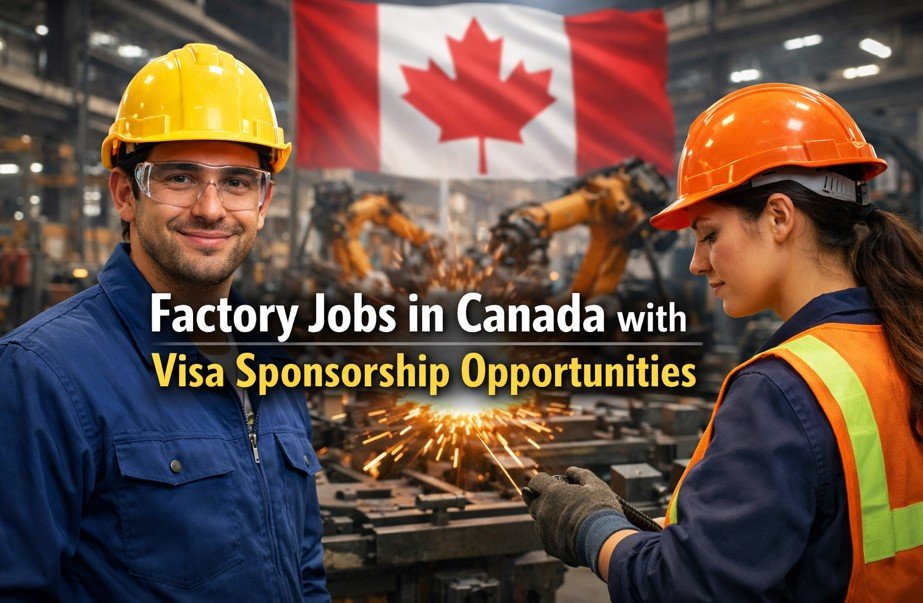
Factory jobs in Canada with visa sponsorship opportunities are becoming a primary gateway for international workers looking to build a stable life in North America.
As the Canadian manufacturing sector continues to expand in 2026, the demand for dedicated personnel in production, assembly, and quality control has reached an all-time high, leading many employers to look beyond their borders to fill critical gaps.
Factory jobs in Canada with visa sponsorship opportunities provide a unique path to residency because they often fall under high-demand labor categories that the Canadian government prioritizes.
Whether you are an experienced machine operator or someone looking for entry-level production roles, understanding how to navigate the “sponsorship” landscape is the first step toward securing a job offer that includes the legal paperwork necessary to move to Canada.
Why the Manufacturing Sector in Canada is Booming in 2026
To understand why factory jobs in Canada with visa sponsorship opportunities are so prevalent right now, we have to look at the massive structural shifts occurring within the country. In 2026, Canada is not just maintaining its industrial base; it is aggressively reinventing it.
Here is an extensive breakdown of the factors driving this historic manufacturing boom.
Unprecedented Federal Investment in Green Technology
The Canadian government has committed over $93 billion toward a net-zero economy by 2050, and 2026 marks a peak period for these capital injections. Massive subsidies and tax credits, such as the Clean Technology Investment Tax Credit, have made Canada a global magnet for “green” factories.
This includes the construction and operation of some of the world’s largest gigafactories for electric vehicle (EV) batteries and solar component assembly. Because these technologies are relatively new, there is a lack of local specialized labor, forcing companies to look internationally.
This surge in “green collar” factory work has directly increased the volume of factory jobs in Canada with visa sponsorship opportunities, as the government fast-tracks permits for projects that lower the national carbon footprint.
A Strategic Pivot Toward National Food Security
In recent years, global supply chain disruptions taught Canada a hard lesson about relying too heavily on imported processed goods. In 2026, the “Made in Canada” movement is no longer just a slogan, it is a matter of national security.
The government has launched a National Food Security Strategy and a $150 million Food Security Fund to expand domestic food processing capabilities.
This has led to the opening of massive new facilities for protein processing, vertical farming, and dairy production. These facilities require thousands of workers to maintain high-volume output.
To meet these targets, the agri-food sector has become the leading user of the Temporary Foreign Worker Program, creating a steady stream of factory jobs in Canada with visa sponsorship opportunities for those in the food science and packaging sectors.
The Rapid Adoption of Industry 4.0 and Smart Manufacturing
While some feared that automation would take jobs away, the reality in 2026 is that “Smart Factories” have created a different kind of demand. Canadian manufacturers are integrating Agentic AI, robotics, and Digital Twins to stay competitive with the U.S. and Europe.
This “Industry 4.0” transition requires a massive workforce to work alongside these machines, operating, troubleshooting, and managing the automated lines.
Companies are finding that they need a hybrid workforce: people with traditional mechanical skills who can also navigate digital interfaces.
To fill these sophisticated roles, employers are increasingly willing to sponsor skilled technicians from abroad who have experience in high-tech manufacturing environments, further boosting the availability of factory jobs in Canada with visa sponsorship opportunities.
Reshoring and Supply Chain Regionalization
In 2026, the trend of “reshoring”, bringing manufacturing back from overseas, has hit full stride. High shipping costs and geopolitical volatility have led Canadian firms to bring production closer to home. By “near-shoring” their supply chains, companies can ensure faster delivery to the North American market.
However, building these factories from the ground up requires an immediate, large-scale workforce that the current Canadian population cannot provide alone.
This urgent need to staff newly reshored plants in the automotive, medical device, and textile industries has made factory jobs in Canada with visa sponsorship opportunities a vital tool for corporate growth and economic resilience.
Addressing the Demographic Labor “Vacuum”
Perhaps the most significant driver of the current boom is the simple reality of Canadian demographics. A record number of the “Baby Boomer” generation has reached retirement age as of 2026, leaving a massive gap in the manufacturing sector.
Statistics Canada reports that for every 10 workers retiring, only about seven are entering the local workforce to replace them. This “labor vacuum” means that factories are often operating at only 70% or 80% capacity simply because they lack the people.
To prevent a total economic slowdown, the government has refined the Recognized Employer Pilot, allowing trusted manufacturers to skip much of the red tape when hiring from abroad.
This demographic shift is the “engine” behind the constant listing of factory jobs in Canada with visa sponsorship opportunities on international job boards.
Factory Jobs in Canada with Visa Sponsorship Opportunities
The landscape of factory jobs in Canada with visa sponsorship opportunities in 2026 offers an incredibly diverse range of roles, each serving as a vital cog in the nation’s industrial machine.
Below are some key positions currently in high demand, complete with their projected salary ranges and detailed insights into why they are prime targets for international recruitment.
1. Food Processing Machine Operator
Average Salary: $19.00 – $26.00 per hour
This role is the backbone of Canada’s massive agri-food sector and is one of the most common factory jobs in Canada with visa sponsorship opportunities. As a machine operator, you are responsible for setting up, operating, and maintaining highly automated equipment used to clean, cut, or package food products.
The shift towards national food security in 2026 means that plants producing dairy, snacks, and frozen goods are constantly running at high capacity.
Employers in this sector frequently seek international workers because these facilities are often located in rural areas where local labor is scarce, making them highly motivated to provide the necessary LMIA (Labour Market Impact Assessment) documentation for your work permit.
2. Meat Cutter and Industrial Butcher
Average Salary: $20.00 – $28.50 per hour
Industrial butchery remains a top-tier category for those seeking factory jobs in Canada with visa sponsorship opportunities due to the specialized physical skills required. Workers in these facilities perform precision cuts on beef, pork, or poultry, ensuring that products meet strict quality and safety standards before they are shipped to retailers.
Because of the intensive nature of the work and a chronic shortage of domestic butchers, major meat-processing companies have established streamlined recruitment pipelines for foreign talent.
This role is particularly advantageous for those seeking permanent residency, as many provinces offer dedicated immigration pathways specifically for workers in the food manufacturing and processing stream.
3. Automotive Assembly Worker
Average Salary: $21.00 – $32.00 per hour
With Canada’s aggressive pivot toward electric vehicle (EV) manufacturing in 2026, automotive assembly has become a high-growth field for factory jobs in Canada with visa sponsorship opportunities.
Assemblers work on massive production lines, using power tools and robotic assistance to install everything from battery packs to interior trims. These roles are often within “Tier 1” supplier plants that provide parts to global giants like Ford or Honda.
Because these companies are investing billions into new green-tech facilities, they require a stable, long-term workforce and are increasingly open to sponsoring skilled assemblers who can commit to several years of service as the industry scales up.
4. Industrial Sewing Machine Operator
Average Salary: $18.50 – $25.00 per hour
While often overlooked, the textile manufacturing sector provides a steady stream of factory jobs in Canada with visa sponsorship opportunities, especially in specialized niches like marine canvas, heavy-duty safety gear, and luxury furniture.
Operators use industrial-grade machines to stitch together heavy fabrics, leather, or synthetic materials. This role requires a high degree of manual dexterity and attention to detail.
Many small-to-medium-sized manufacturers struggle to find local talent with these specific vocational skills, leading them to search globally. These positions often offer a very comfortable work-life balance compared to heavier industrial roles, making them a popular choice for international applicants.
5. Metal Fabricator and Welder
Average Salary: $24.00 – $39.00 per hour
Welding is consistently ranked as one of the most in-demand trade-based factory jobs in Canada with visa sponsorship opportunities due to its critical role in infrastructure and heavy machinery production.
Whether you specialize in MIG, TIG, or arc welding, your ability to fuse metal components together is a highly portable skill that Canadian employers are desperate to secure.
In 2026, the demand is particularly high in factories producing construction equipment and energy-sector components. Because this is a skilled trade, employers are often willing to pay a premium and handle all legal sponsorship costs to ensure they have the expertise needed to fulfill their manufacturing contracts.
6. Warehouse Material Handler
Average Salary: $18.00 – $24.00 per hour
Material handlers are the logistics experts within a factory setting, ensuring that raw materials reach the production line and finished goods are moved to the shipping docks.
These factory jobs in Canada with visa sponsorship opportunities often involve operating forklifts, pallet jacks, and automated retrieval systems. As factories adopt more sophisticated inventory management software in 2026, the role has evolved to include data entry and digital scanning responsibilities.
Companies managing large-scale distribution hubs are frequent sponsors, as the sheer volume of goods moving through Canadian ports and factories requires a massive, reliable labor force that exceeds local availability.
7. Quality Control Inspector
Average Salary: $22.00 – $30.00 per hour
Quality control (QC) is a vital function in high-precision environments like pharmaceutical or aerospace manufacturing.
In these factory jobs in Canada with visa sponsorship opportunities, inspectors use measuring tools and digital scanners to ensure every product meets exact specifications and safety regulations.
In 2026, as manufacturing becomes more automated, the human element of QC is more important than ever to catch errors that machines might miss.
International candidates with a background in engineering or previous industrial inspection experience are highly valued, and employers often provide sponsorship to secure workers who have a proven track record of maintaining high standards in fast-paced environments.
8. Plastics Processing Machine Operator
Average Salary: $19.50 – $27.00 per hour
The manufacturing of essential plastic components, ranging from medical supplies to sustainable packaging, relies on injection molding and blow molding operators.
These factory jobs in Canada with visa sponsorship opportunities involve monitoring computerized control panels, troubleshooting mechanical issues, and performing routine maintenance on the molds.
Because the plastics industry is deeply integrated into every other sector of the economy, it remains recession-proof.
Factories in this sector are currently expanding their “circular economy” initiatives to include more recycled materials, creating a surge in demand for operators who can adapt to new, sustainable production techniques and materials.
9. Millwright and Maintenance Mechanic
Average Salary: $30.00 – $45.00 per hour
If you have a talent for fixing complex machinery, millwright roles are among the highest-paying factory jobs in Canada with visa sponsorship opportunities. Millwrights are responsible for installing, dismantling, and repairing the heavy equipment used across all manufacturing sectors.
In 2026, as factories become “smarter” and more interconnected, the need for mechanics who understand both mechanical gears and electronic sensors is skyrocketing.
Because of the high level of technical training required, Canadian firms frequently utilize international recruitment to find seasoned mechanics who can keep their multi-million dollar production lines running without downtime.
10. Fish and Seafood Processing Labourer
Average Salary: $17.50 – $22.00 per hour
On Canada’s coasts, the seafood industry is a massive driver of the economy and a major source of factory jobs in Canada with visa sponsorship opportunities. Labourers in these plants handle the cleaning, grading, and packaging of everything from Atlantic salmon to Pacific shellfish.
This work is often seasonal but can lead to year-round employment as processing technology allows for longer shelf lives.
The federal government often provides special exemptions and faster processing times for seafood workers due to the industry’s importance to regional economies, making this one of the quickest routes for an international worker to enter the Canadian workforce.
11. Wood Product Manufacturing Labourer
Average Salary: $18.00 – $25.50 per hour
Canada’s forestry sector feeds into massive factories that produce everything from pre-fabricated homes to high-end cabinetry. These factory jobs in Canada with visa sponsorship opportunities involve operating saws, sanders, and CNC (Computer Numerical Control) routers.
With the 2026 housing boom in full swing, the demand for building materials is at an all-time high. Employers are looking for reliable workers who can handle the physical demands of wood processing while maintaining a high level of accuracy.
Sponsorship is common in this sector, particularly for those with experience in modern, computerized wood-working environments.
12. Chemical Plant Operator
Average Salary: $26.00 – $38.00 per hour
Operating a chemical processing plant requires a focus on safety and a deep understanding of industrial protocols.
These factory jobs in Canada with visa sponsorship opportunities involve monitoring chemical reactions, adjusting temperatures, and ensuring that all environmental regulations are strictly followed.
As Canada expands its production of fertilizers and industrial cleaners in 2026, the need for experienced operators is growing.
Because the safety risks are higher in this sector, companies prioritize experience over all else and are willing to navigate the complex visa sponsorship process to bring in seasoned professionals from the global chemical industry.
13. Electronics Assembler
Average Salary: $19.00 – $26.50 per hour
As Canada builds out its domestic tech manufacturing, electronics assembly has emerged as a key area for factory jobs in Canada with visa sponsorship opportunities.
This role involves soldering circuit boards, assembling micro-components, and testing finished electronic devices. These factories are typically “clean room” environments that require high levels of concentration and precision.
With the global shift toward regionalizing the production of microelectronics and IoT (Internet of Things) devices, Canadian electronics firms are aggressively hiring and sponsoring international workers who have experience in high-tech assembly lines.
14. Packaging and Shipping Coordinator
Average Salary: $19.00 – $25.00 per hour
The final step in the manufacturing process is getting the product safely to the customer, which is where packaging coordinators come in.
These factory jobs in Canada with visa sponsorship opportunities go beyond simple box-taping; they involve managing automated palletizers, coordinating with logistics software, and ensuring that all international shipping labels and customs documentation are correct.
In 2026, as e-commerce and direct-to-consumer manufacturing continue to dominate, the role of the shipping coordinator has become more technical and critical to a factory’s bottom line, leading many firms to offer sponsorship to organized and tech-savvy international candidates.
Understanding the Visa Sponsorship Process for Factory Jobs in Canada
To successfully land factory jobs in Canada with visa sponsorship opportunities in 2026, you must navigate a multi-layered legal process designed to protect both the Canadian labor market and the international worker.
The journey from a job search to a valid work permit involves specific regulatory steps that ensure your employment is legitimate, fair, and legally recognized by the Canadian government.
Here is an extensive breakdown of the visa sponsorship process for the manufacturing sector.
The Crucial Role of the Labour Market Impact Assessment (LMIA)
The cornerstone of securing factory jobs in Canada with visa sponsorship opportunities is the Labour Market Impact Assessment, LMIA. This is a document that your prospective employer must apply for through Employment and Social Development Canada (ESDC).
The purpose of the LMIA is to prove that the employer has made a genuine effort to hire a Canadian citizen or permanent resident but was unsuccessful, thereby justifying the need to hire a foreign national.
In 2026, the LMIA process has become more digitized and transparent, but it remains a rigorous check. A “positive” LMIA confirms that hiring you will have a neutral or positive effect on the local economy, and it is the essential “golden ticket” you need before you can even begin your work permit application.
Understanding the 2026 Recognized Employer Pilot (REP)
For many seeking factory jobs in Canada with visa sponsorship opportunities, the Recognized Employer Pilot (REP) is a major advantage. This program, which is fully operational in 2026, allows “trusted” employers, those with a clean history of compliance and high standards, to access a streamlined version of the LMIA.
Under the REP, a factory can obtain an LMIA that is valid for up to 36 months, significantly longer than the standard 12-month validity.
This means the employer doesn’t have to re-apply every year, making them much more likely to hire international workers for long-term production roles. For you, this translates to more job security and a smoother transition if you decide to extend your stay in Canada.
Navigating High-Wage vs. Low-Wage Work Permit Streams
When applying for factory jobs in Canada with visa sponsorship opportunities, the specific “stream” of your work permit depends on the hourly wage offered.
If the wage is at or above the provincial median, you fall into the High-Wage Stream, which often requires a “Transition Plan” from the employer detailing how they will eventually reduce their reliance on foreign labor.
If the wage is below the median, common for entry-level assembly or packaging roles, it falls under the Low-Wage Stream.
In 2026, the government maintains a “cap” on the percentage of low-wage foreign workers a factory can employ (typically 20% to 30% depending on the sector), so it is wise to target specialized roles or high-demand regions where these caps are more flexible.
The Mandatory Employment Agreement and Worker Rights
A critical step in the process for factory jobs in Canada with visa sponsorship opportunities is the signing of a formal Employment Agreement.
By law, your Canadian employer must provide a written contract that outlines your wages, duties, and working conditions in your preferred language (English or French). This agreement must be signed by both parties before the LMIA is finalized.
In 2026, Canadian law is extremely strict about worker protections; the contract must guarantee that the employer will pay for your round-trip transportation (for low-wage roles), provide or help find affordable housing, and ensure you are covered by workplace safety insurance from day one.
This document acts as your legal safeguard, ensuring that the terms of your sponsorship are honored throughout your tenure.
Transitioning from Work Permit to Permanent Residency (PR)
The ultimate goal for many who secure factory jobs in Canada with visa sponsorship opportunities is to stay in the country permanently. In 2026, the path from a “closed” work permit to Permanent Residency has been modernized through “Category-Based Selection” in the Express Entry system.
Manufacturing and trade occupations are frequently targeted in these draws, allowing factory workers with at least one year of Canadian experience to bypass higher point requirements.
Additionally, the government’s 2026–2028 Immigration Levels Plan includes a specialized pathway to transition up to 33,000 temporary workers directly to PR status. This makes factory work not just a temporary job, but a high-probability stepping stone to becoming a Canadian citizen.
Conclusion
The path to securing factory jobs in Canada with visa sponsorship opportunities requires patience and a proactive approach. By targeting the right industries, like food processing and automotive, and using official government resources like the Job Bank, you can find a legitimate employer willing to invest in your future. Canada’s manufacturing sector isn’t just looking for laborers; it’s looking for the next generation of its workforce. With the right preparation, that could be you.