Scholarships in Germany for International Students
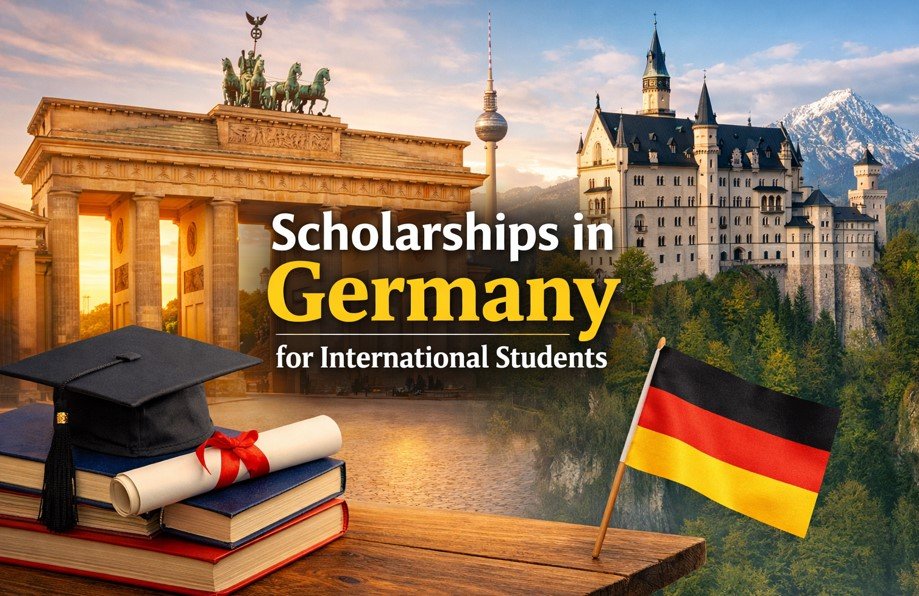
Scholarships in Germany for international students are the golden ticket for thousands of aspiring scholars every year.
As we move into 2026, the landscape of higher education in Germany remains one of the most attractive in the world, offering a unique blend of world-class academic standards and significantly lower tuition costs than many other Western nations.
Scholarships in Germany for international students play a pivotal role in making this dream accessible, ensuring that financial barriers do not stand in the way of talent.
Whether you are aiming for a Master’s degree in engineering or a PhD in the social sciences, understanding the diverse range of funding options available, from government grants to private foundation awards, is the first step toward your European academic journey.
Why Choose Scholarships in Germany in 2026?
As we look toward the 2026 academic year, the decision to pursue scholarships in Germany for international students has never been more compelling.
Germany has evolved from a traditional center of European learning into a hyper-modern global education hub, specifically tailored to the needs of the mid-2020s workforce. Here is why securing funding in Germany is the smartest move for your future.
Unparalleled Financial Freedom in a Global Inflationary Era
In 2026, the global cost of higher education continues to rise, but Germany remains a steadfast exception. While universities in the US, UK, and Australia have seen significant tuition hikes, German public universities maintain their commitment to tuition-free education.
By securing scholarships in Germany for international students, you aren’t just covering a “discounted” fee; you are often eliminating the cost of living entirely.
With the standard blocked account requirement sitting at roughly €11,904 per year, a full scholarship provides a level of financial peace that allows you to focus 100% on your research and innovation rather than part-time shifts.
A World-Class Education System Built on “Vorsprung durch Technik”
The German reputation for technical excellence, “Progress through Technology”, is at its peak in 2026. German degrees are globally recognized as a gold standard for quality and rigor.
By choosing scholarships in Germany for international students, you gain access to 15 institutions currently leading the global charts in STEM and Engineering. The 2026 curriculum in Germany is uniquely research-driven; the “Excellence Strategy” now allocates over €500 million annually to specialized research hubs.
This means as a scholarship holder, you aren’t just a student; you are a junior researcher working on the front lines of Artificial Intelligence, Green Energy, and Quantum Computing.
Record-Breaking Career Prospects and Labor Market Demand
Germany is currently facing a historic demand for skilled international talent. By 2026, the “Make it in Germany” initiative has simplified pathways for graduates like never before.
Winning one of the many scholarships in Germany for international students places you directly in the sights of industry giants like Siemens, SAP, and BMW. The 18-month post-study work visa remains one of the most generous in the world, and in 2026, the transition to an EU Blue Card has been streamlined.
With starting salaries for STEM graduates often exceeding €50,000, your scholarship is essentially an investment with an immediate, high-value return.
Integration into a High-Tech, Digitalized Academic Landscape
Digitalization in German higher education has taken a massive leap forward by 2026. Universities now offer over 2,400 English-taught programs, making the language barrier a thing of the past for academic success.
Furthermore, the DAAD and other funding bodies have introduced “Digital Prep” programs (like VORsprung) that allow scholarship recipients to begin their integration and language training online before they even set foot in Europe.
This hybrid approach ensures that when you arrive, you are already technically and culturally equipped to excel in a high-performance environment.
A Safe, Multicultural, and Stable Social Environment
In an era of global political shifts, Germany stands out as a beacon of stability and safety. It remains ranked among the top 10 most stable countries globally in 2026, offering a liberal and welcoming atmosphere for students from all backgrounds.
Scholarships in Germany for international students often come with “soft-skill” support, including networking events, cultural excursions, and integration workshops provided by foundations like the Konrad-Adenauer or Friedrich-Ebert Stiftung.
You aren’t just moving for a degree; you are moving to a society that values your perspective and protects your rights as a resident.
Scholarships in Germany for International Students
To truly understand the landscape of scholarships in Germany for international students, one must look at the immense variety of funding sources available in 2026. From government-backed giants to niche private foundations, these programs offer a pathway for every type of scholar.
1. DAAD Study Scholarships for Master’s Students
Scholarships in Germany for international students through the DAAD (German Academic Exchange Service) are arguably the most prestigious and well-known. In 2026, the DAAD continues to offer its “Study Scholarships” for graduates of all academic disciplines who wish to pursue a Master’s degree.
These scholarships provide a monthly stipend of €992, which is designed to cover the updated 2026 cost-of-living requirements. Beyond the cash allowance, recipients benefit from a comprehensive health, accident, and personal liability insurance package, along with a one-time annual study allowance of €460.
The DAAD also frequently funds a multi-month German language course before the actual study program begins, ensuring that scholars are culturally and linguistically integrated before they enter the classroom.
2. The Deutschlandstipendium (National Scholarship)
The Deutschlandstipendium represents a unique synergy between the German government and private industry. This program is one of the few scholarships in Germany for international students that is open to applicants regardless of their personal income or their parents’ financial status.
It awards €300 per month, half of which is provided by the federal government and the other half by private sponsors such as regional companies or foundations.
Because it is merit-based, universities look for exceptional grades, but they also place a massive 50% weight on “social commitment,” such as volunteering or overcoming significant personal hurdles. It is an excellent “top-up” for students who may have some savings but need an extra cushion to cover rising rent costs in 2026.
3. Heinrich Böll Foundation Scholarships
If you are an international student with a deep interest in ecology, sustainability, and human rights, the Heinrich Böll Foundation is your primary target.
These scholarships in Germany for international students are specifically earmarked for those who identify with the values of the Green Party. For the 2026 cycle, non-EU students pursuing a Master’s degree receive a basic stipend of €992 per month, plus various allowances for health insurance.
A key requirement for this foundation is a demonstrated B2 or DSH-1 level of German proficiency, as the foundation views its scholars as future socio-political leaders who must be able to engage in German public discourse.
4. Erasmus+ Joint Master Degrees (EMJM)
Erasmus+ remains the flagship of European educational mobility. The Erasmus Mundus Joint Masters are high-level, integrated study programs delivered by a consortium of at least three different European universities.
While the availability of these scholarships in Germany for international students can fluctuate by cohort, successful applicants for the 2026 intake can expect a substantial monthly allowance of €1,400.
This makes it one of the highest-paying scholarships in Europe. The grant is “all-inclusive,” meaning it covers your tuition fees, insurance, and travel costs while allowing you to study in at least two different European countries during your degree.
5. Konrad-Adenauer-Stiftung (KAS) Scholarships
The KAS is a political foundation associated with the Christian Democratic Union (CDU), and it focuses heavily on students who are committed to democracy and the rule of law.
These scholarships in Germany for international students are available for both Master’s and PhD candidates. In 2026, Master’s students receive €934 per month, while PhD candidates are awarded €1,400 per month.
KAS is famous for its “non-material support,” which includes an extensive network of seminars, study groups, and networking events designed to build a global elite of pro-democracy thinkers. Applicants must have a university degree and prove above-average academic performance.
6. Friedrich Ebert Stiftung (FES) Scholarships
Named after the first democratically elected German president, the FES supports the values of social democracy. These scholarships in Germany for international students are ideal for those who have a strong background in social or political activism.
For the 2026/2027 academic year, the foundation offers up to €992 per month for Master’s students and a generous €1,500 per month for doctoral researchers.
One of the most distinctive features of FES is the “Trusted Lecturer” network, over 480 professors across Germany who act as mentors and advisors to the scholarship holders, ensuring that students have a personal guide throughout their academic journey.
7. Bayer Foundation Scientific Fellowships
For students in the life sciences, chemistry, or medicine, the Bayer Foundation offers a specialized alternative to traditional government grants.
These scholarships in Germany for international students focus on international mobility, providing up to €10,000 for research placements, internships, or special projects lasting up to six months.
In 2026, the foundation has introduced a specific “Fellowship for Climate & Health,” targeting the intersection of environmental science and public health. This is a “mobility-first” scholarship; if you are currently studying outside of Germany, the funds must be used to bring your research to a German institution.
8. Rosa-Luxemburg-Stiftung Scholarships
The Rosa-Luxemburg-Stiftung is the political foundation of the Left Party (Die Linke), and it prioritizes social justice and critical thinking. Among the various scholarships in Germany for international students, this foundation stands out for its specific focus on “historically disadvantaged” groups.
They actively encourage applications from women, from non-academic backgrounds, and those with disabilities. For 2026, PhD scholars receive €1,350 per month plus a €100 research lump sum.
Like other political foundations, it requires a B2 level of German, but it offers one of the most intellectually stimulating communities for those interested in socialist theory and social activism.
9. Friedrich Naumann Foundation for Freedom
Focused on liberal values and “cosmopolitanism,” the Friedrich Naumann Foundation supports international students who are committed to individual freedom and the market economy.
These scholarships in Germany for international students are open to non-EU Master’s and PhD applicants. In 2026, the monthly stipend for Master’s students is set at €934, while PhD candidates receive €1,200.
The foundation looks for “independent minds”, students who aren’t just high achievers but are also willing to take responsibility and make decisions in the fields of politics, economics, or culture.
10. Hanns Seidel Foundation Scholarships
The Hanns Seidel Foundation (HSF) is based in Bavaria and focuses on the motto “In the Service of Democracy, Peace, and Development.”
These scholarships in Germany for international students are unique because they have an “open” deadline, applications are accepted year-round, with selection rounds usually occurring in January and July. In 2026, they offer up to €992 for Master’s students and €1,300 for PhDs.
The foundation is particularly interested in students who plan to return to their home countries after their studies to apply their knowledge in a development-oriented context.
11. SBW Berlin Scholarship
For students specifically eyeing the capital city, the SBW Berlin Scholarship is a specialized opportunity. These scholarships in Germany for international students are for those aged 18 to 30 with low household incomes.
Unlike most other grants, SBW Berlin often provides a fully furnished room in one of their shared student apartments in Berlin or Potsdam, along with a monthly allowance.
The catch is that recipients are expected to develop and implement a “social project” during their studies that benefits their home country, and there is an expectation that you will return home to continue this work after graduation.
12. DKFZ International PhD Program (Cancer Research)
The German Cancer Research Center (DKFZ) in Heidelberg offers one of the most prestigious science-specific scholarships in Germany for international students. This is a fully funded program where PhD students are treated almost like staff members, receiving a competitive salary rather than a mere stipend.
For the 2026 cycle, the program is conducted entirely in English, and the funding covers the full three to four years of the doctorate. It is highly competitive, targeting the top 5% of graduates in molecular biology, chemistry, and computational biology.
13. Boehringer Ingelheim Fonds (BIF) PhD Fellowships
BIF offers “certificates of excellence” in the form of PhD fellowships for junior scientists worldwide. These scholarships in Germany for international students focus on basic biomedical research.
In 2026, the monthly stipend is approximately €2,200 (depending on the location and currency fluctuations), making it one of the most financially rewarding fellowships available.
The selection process is grueling, with an acceptance rate of less than 10%, but it provides entry into an elite worldwide network of biomedical researchers.
14. KAAD Scholarships (Catholic Academic Exchange Service)
Despite the name, the KAAD is not only for Catholics; it is open to all Christians and even non-Christians who are proposed by Catholic partners and are committed to interreligious dialogue.
These scholarships in Germany for international students are primarily for postgraduates from developing or emerging countries. In 2026, the KAAD continues to offer Master’s and PhD funding that includes a preparatory language course of up to six months.
They place a high value on “reintegration,” meaning they look for applicants who have a clear plan for how their German education will benefit their community back home.
Key Criteria for Securing Scholarships in Germany for International Students
Understanding the key selection criteria for scholarships in Germany for international students is the difference between a rejected application and a life-changing acceptance letter.
For the 2026 academic year, committees have refined their expectations to prioritize not just high achievers, but individuals who demonstrate specific professional, social, and personal traits.
Exceptional Academic Performance (GPA and NC Standards)
The most fundamental pillar of scholarships in Germany for international students remains academic excellence.
For merit-based awards like the Deutschlandstipendium or DAAD study grants, committees look for a Grade Point Average (GPA) that typically places the student in the top 10% to 20% of their graduating class. In the German grading system, this usually translates to a grade between 1.0 and 1.5.
Even for holistic scholarships, your “Transcript of Records” acts as the primary filter. If you are applying for a Master’s or PhD, selection panels will look closely at the relevance of your previous modules to your target program to ensure you have the foundational knowledge to succeed in Germany’s rigorous academic environment.
Professional and Practical Experience
For many specific scholarships in Germany for international students, such as the DAAD EPOS (Development-Related Postgraduate Courses), academic grades alone are not enough. These programs often mandate at least two years of professional work experience in a relevant field.
The committee wants to see that you have applied your undergraduate knowledge in the real world and that you have a clear understanding of the challenges in your industry.
This experience should ideally be within a government organization, an NGO, or a private company that contributes to national development. In your CV, you must highlight not just your job title, but your specific achievements and responsibilities.
Language Proficiency (The B2/C1 Standard)
Language skills are a non-negotiable criterion for scholarships in Germany for international students. Even if your chosen Master’s program is taught in English, most political and religious foundations (like the Konrad-Adenauer-Stiftung) require at least a B2 level of German proficiency.
This is because these organizations view the scholarship as a tool for socio-political integration. For English-taught programs, you will typically need an IELTS score of 6.5 or higher or a TOEFL score of 90+.
In 2026, many universities have also begun accepting the Duolingo English Test (DET) with scores of 115+, though you should always verify this for each specific grant.
Social Commitment and Volunteering
A unique feature of scholarships in Germany for international students is the high value placed on “social commitment” (Gesellschaftliches Engagement).
German foundations are often funded by taxpayers or ideological organizations that want to support “multipliers”, people who will give back to society. If you have spent time volunteering at a local charity, leading a student union, or participating in political activism, this must be a centerpiece of your application.
Committees look for evidence that you are socially aware, empathetic, and willing to take on responsibility beyond your personal career goals.
A High-Impact Letter of Motivation
The Statement of Purpose (SOP) is where you breathe life into your data. For scholarships in Germany for international students, the motivation letter must be precise, usually between one and three pages. It should answer three critical questions:
- Why this specific program in Germany?
- How does it align with your past experiences?
- exactly how will you use this knowledge to benefit your home country or the global community?
Avoid generic praise of Germany’s “excellent education”; instead, mention specific research labs, professors, or modules that only that university provides.
Strong Academic and Professional Recommendations
Your application must be backed by authoritative voices. Most scholarships in Germany for international students require at least one or two letters of recommendation from university professors or senior employers.
These letters should not just be “good”; they need to be specific. A letter that says “Student X was in the top 5% of my class and showed exceptional skill in statistical modeling” is far more valuable than one that says “Student X is a hard worker.”
In 2026, these letters are often submitted through secure online portals, so you must ensure your referees are aware of the digital deadlines.
The “6-Year Rule” for Recent Graduates
A common technical hurdle for scholarships in Germany for international students, particularly those from the DAAD, is the recency of your degree. As a general rule, your last academic degree should not be more than six years old at the time of application.
While there are exceptions for pregnancy, childcare, or military service, committees generally prefer “fresh” academics who are in a continuous phase of learning and development. If your degree is older, you will need a very strong justification for why you are returning to academia now.
Alignment with Developmental or Political Goals
Finally, many scholarships in Germany for international students have specific “target” themes. If you are applying for a scholarship from the Heinrich Böll Foundation, your research or career goals should ideally align with sustainability or human rights.
If you are applying for Friedrich Ebert, social justice should be your focus. Understanding the “mission statement” of the funding body and weaving their values into your application is often the final key that unlocks the funding.
Conclusion
Applying for scholarships in Germany for international students requires patience and meticulous planning. However, the reward, a world-class education in the heart of Europe, is worth every hour spent on your application. Germany doesn’t just offer you a seat in a lecture hall; it offers a global perspective and a chance to be part of the next generation of innovators.